
Forty Days of Mourning, and the Architecture of Silence
Reading Saleema through patriarchy, discipline, and survival
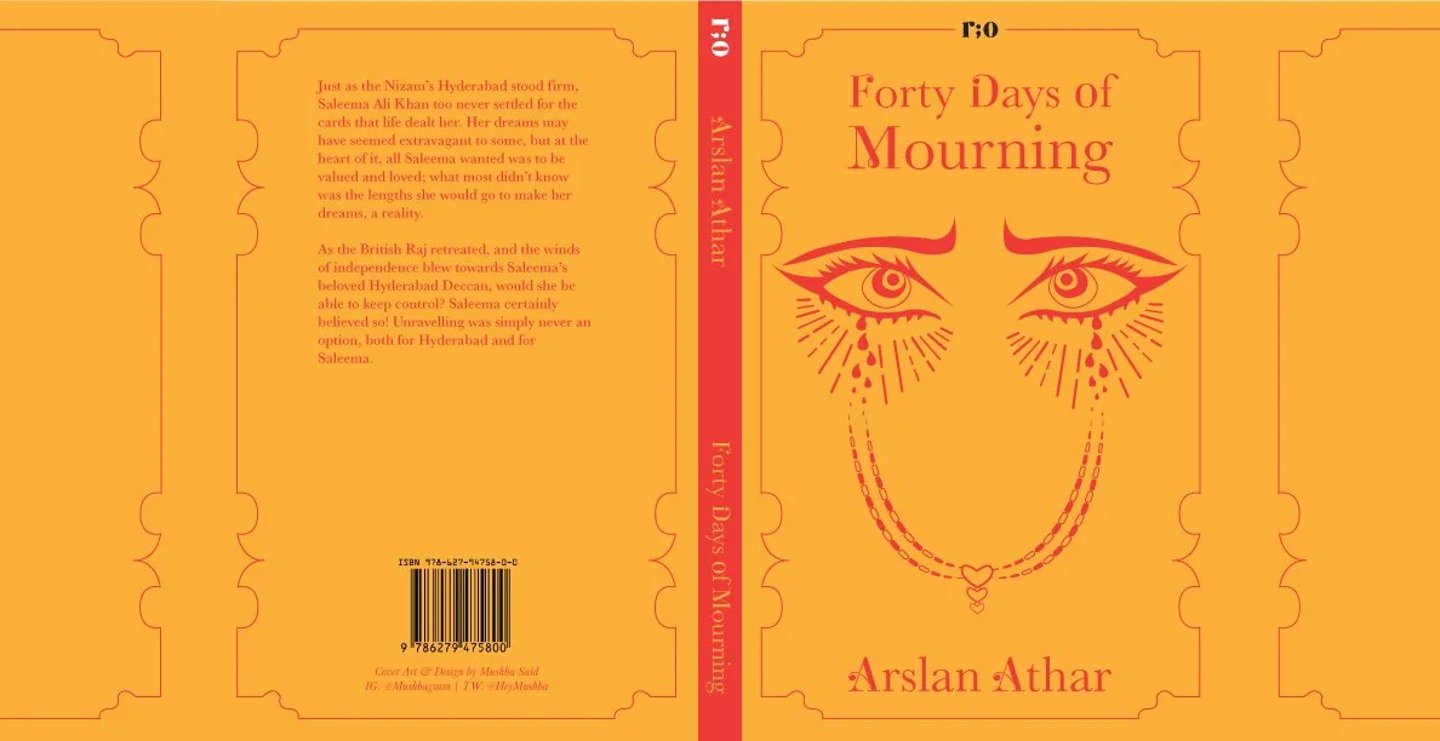

I did not plan to write about Forty Days of Mourning. Not until I finished the book. Not until Saleema stayed with me longer than I expected a fictional character to stay.
Saleema carries secrets. She wants love. She loves her family. She wants other women to thrive, even when she herself cannot.
This is not an easy story to sit with. It is rough, unsettling, and at times deeply uncomfortable. You may feel anger, confusion, even helplessness while reading it. But if the story does anything, it forces us to look at the lives women live inside systems that do not give them many choices to begin with.
This is not a space to judge Saleema.
Not a space to ridicule her, or excuse her, or condemn her.
Because the truth is simple, and also difficult:
what happens to Saleema happens to many women.
In societies shaped by strict moral codes, women are often given only two categories in which they are allowed to exist: victim or adulteress.
Very rarely human.
Saleema’s story asks us to consider a third possibility: survival.
Waiting for a Future Already Decided
Saleema’s life begins in a way that feels familiar across South Asia. Her marriage is arranged when she is still young, before she understands what marriage means, before she has the language to imagine herself as an individual.
Simone de Beauvoir once wrote that every young girl grows up in waiting — waiting for the man who will define her future. Reading Salima, it feels as if that sentence was written for her. Her life does not move toward adulthood. Adulthood moves toward her.
Puberty does not bring freedom.
It brings surveillance.
Her body begins to matter, but not to her. It matters to the household, to relatives, to the future in-laws, to the social order that will decide where she belongs.
Scholars describe this as classic patriarchy — a system that exists across South Asia, the Middle East, and many other parts of the world, where a girl does not grow up imagining what she will become, but whom she will be given to. Saleema accepts her engagement wholeheartedly, not because she has chosen it, but because in such systems obedience is not submission.
It is survival.
When a Glance Becomes a Scandal
One of the turning points in her life comes in a moment that seems small. She is seen standing too close to another man in the kitchen. Nothing actually happens, yet the consequences are severe. The engagement breaks, her reputation changes, and her future shifts. The reaction is not about the act itself, but about what it threatens. In patriarchal family systems, a woman’s sexuality is never only personal. It belongs to the lineage she is meant to enter.
Anthropologists describe this through the idea of the patriline, a line of descent traced through men, where identity, inheritance, and honor move from father to son. Within such a structure, a woman’s body becomes the guarantee of purity. Even proximity can become scandal. Even a glance can become betrayal.
What happens in the kitchen is not just embarrassment. It is the moment Salima becomes visible to herself and to others at the same time.
De Beauvoir describes this moment as the point when a young girl begins to see herself both as subject and as object, aware that she is being looked at. For Salima, that awareness is dangerous. Visibility inside such a system is risk. Soon after, her marriage is arranged again, not as a love story, but as correction, as containment, as damage control.
Marriage as Absorption, Not Union
She is married to a man who already has a wife, and she enters the household with very little bargaining power. Even when religion or law grants women certain rights, culture often makes claiming those rights costly. To ask for more can mean losing protection altogether. Saleema enters the marriage without security, without patrimony, and without the freedom to negotiate. Her only way to secure her place in the new family is through motherhood.
Classic patriarchy is built on the patrilocal household, where a woman leaves her family and moves into her husband’s home.
She does not marry only a man.
She enters a structure.
There are senior men whose authority is unquestioned.
There are older women who have survived the same system and now enforce its rules.
There is already a hierarchy, already a history.
Saleema’s body, her labor, her children — all become part of the husband’s lineage.
This is not cruelty in the obvious sense.
It is order.
The Good Wife and the Cost of Silence
She is married to a man who already has a wife, and she enters the household with very little bargaining power. Even when religion or law grants women certain rights, culture often makes claiming those rights costly. To ask for more can mean losing protection altogether.
Salima enters the marriage without security, without patrimony, and without the freedom to negotiate. Her only way to secure her place in the new family is through motherhood.
Classic patriarchy is built on the patrilocal household, where a woman leaves her family and moves into her husband’s home. She does not marry only a man; she enters a structure. There are senior men whose authority is unquestioned, older women who have already survived the same system, and a hierarchy that existed long before she arrived.
Her body, her labor, and her children all become part of the husband’s lineage.
Power Moves in Circles
Very early in the marriage, Saleema learns what is expected of her. A good wife maintains honor. A good wife does not complain. A good wife adjusts. Even when she feels neglected, even when she feels unseen, even when she longs for emotional intimacy she never receives, she continues to silence herself.
Psychologists describe this pattern as self-silencing, when a person suppresses their needs in order to preserve relationships.
At first it looks like patience, then sacrifice, then virtue. Over time, however, something begins to erode. Anger has nowhere to go. Loneliness grows quietly. The sense of self becomes smaller and smaller, until a person begins to disappear even in their own eyes.
Inside the household, Saleema begins at the lowest position in the hierarchy, below the men, below the older women, below the first wife. Yet the system promises something in return.
If she survives long enough, if she has sons, if she remains obedient, one day she will have authority over younger women.
Power in such families moves in circles. First you endure, then you control. This circular structure is one of the reasons patriarchy survives so effectively. Those who suffer within it are eventually given a chance to enforce it. The system does not need to be defended loudly; it reproduces itself quietly.
The Disciplined Body
Michel Foucault wrote about how power works not only through force, but through discipline.
He described how soldiers are trained — their posture, their movement, their gestures controlled until the body itself becomes obedient.
Saleema’s life follows a similar logic.
She learns how to walk.
How to sit.
How to speak.
When to stay silent.
How to pour tea.
How to behave at funerals.
How to exist without attracting attention.
No one needs to watch her all the time.
She watches herself.
Foucault called this internalized surveillance the panopticon — a system where you behave as if you are always being observed, even when no one is looking.
Saleema lives inside that invisible architecture of power.
Her freedom is limited not only by rules, but by the rules she has learned to enforce on herself.
Desire, Guilt, and the Narrow Moral World
Later in the story, Saleema forms a connection with Naveed.
It is not a simple love story.
It is not even a simple mistake.
It is what happens when a life lived in restraint suddenly encounters attention.
But the system offers her only two identities:
innocent or immoral.
So when she is caught, she chooses the language that protects her — the language of violation.
This is not about truth or lies.
It is about the limited moral categories available to her.
Women in rigid social systems often become experts in survival.
They learn how to negotiate silence, affection, motherhood, and reputation in order to stay safe.
Saleema’s choices are shaped by fear, by duty, by habit, by the knowledge that one wrong move can destroy everything.
Marriage Protects, and Marriage Traps
Marriage promises security, legitimacy, respectability.
But it also confines.
A woman is told her dignity lies in the household.
Her future lies in children.
Her honor lies in obedience.
Meanwhile, the husband moves freely between public and private life.
Even when Saleema wants to know more about his world, she is kept at the edge of it.
She is inside the family.
Never at the center of power.
When the order finally breaks after her husband’s death, the shift is sudden. The man who was once subordinate rises.
Old hierarchies collapse. Revenge enters the story. Patriarchy is never as stable as it appears; it depends on political order, family order, and social order. When those structures change, everything changes.
Yet the deepest tragedy in Saleema’s story is not revenge. It is silence. She never tells her daughters the truth. She protects the same structure that once suffocated her, because it is the only structure she knows how to live inside.
De Beauvoir wrote that women often internalize the system that limits them. It becomes part of who they are. What survives quietly is rarely explained. What is not explained is repeated.
Why Saleema Feels Familiar
She is not immoral, not weak, not unusually tragic. She is ordinary in the most unsettling way. Her life follows a script many women recognize: engagement, marriage, adjustment, silence, motherhood, secrecy, survival. Each moment feels personal, but together they form a pattern shaped by a social order that teaches girls to wait, to please, to endure, and to protect the family even at the cost of themselves.
Survival is possible inside this structure.
Freedom rarely is.
That is why Saleema’s story feels so familiar.
Not because we would make the same choices,
but because we recognize the world in which those choices become inevitable.


Sarosh Ibrahim
Researcher
Feb 24, 2026
© 2025. All rights reserved.


A platform exploring body politics, culture, and identity in Pakistan and beyond.